

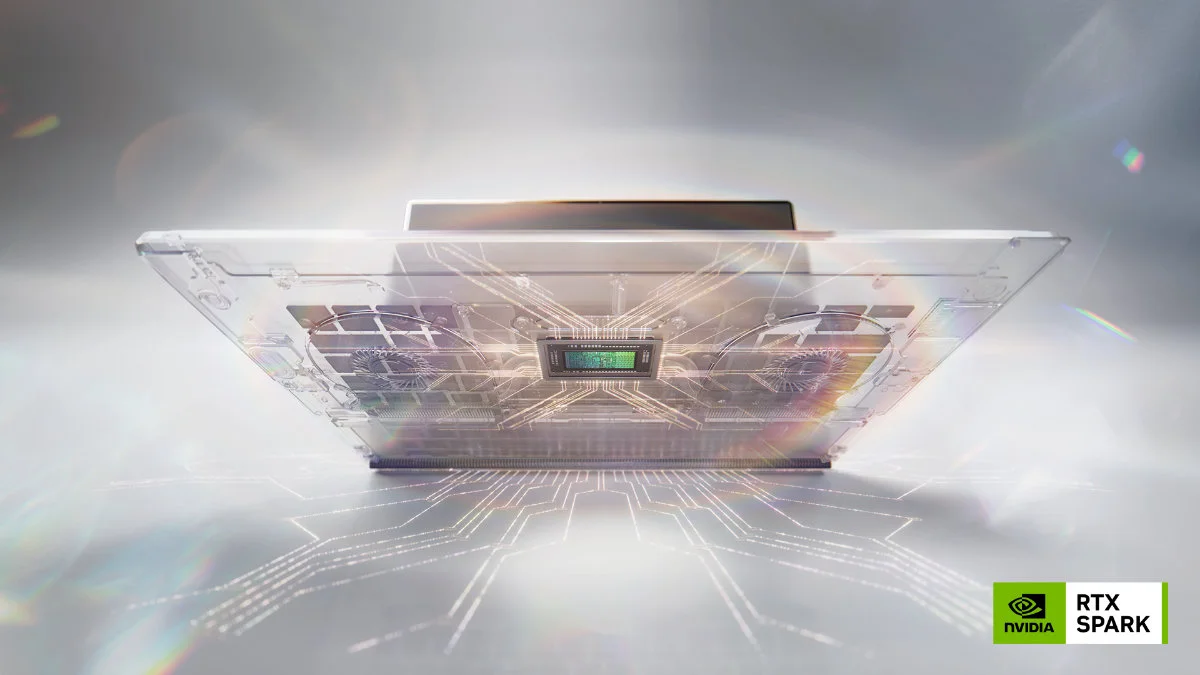
TL;DR: The Paradigm Shift: For four decades, the personal computer operated as a reactive typewriter—you click, you type, an app launches. The introduction of NVIDIA RTX Spark (N1X) shifts the architecture from a passive tool to an autonomous local AI teammate. The Architectural Solution: This highly integrated, Arm-based superchip unifies an NVIDIA Blackwell RTX GPU and a custom 20-core NVIDIA Grace CPU (co-designed with MediaTek) over an NVLink-C2C interconnect. Delivering 1 Petaflop of local FP4 compute and up to 128GB of unified memory, it breaks the traditional x86 power-to-performance barrier. This allows slim, all-day-battery laptops like the HP OmniBook Ultra 16 and HP OmniBook X 14 to run massive 120-billion parameter LLMs completely offline.
Beyond the Chatbot: The Move to Agentic Silicon
The consumer tech industry is suffering from AI feature fatigue. Up until now, “AI PCs” have largely been defined by isolated cloud-connected prompts, dedicated keyboard buttons, and basic photo-editing tricks. The silicon underlying these machines was never engineered for continuous, autonomous computation.
The launch of the NVIDIA RTX Spark platform—developed under the internal designation NVIDIA N1X—marks the official end of the speculative AI era.
NVIDIA and Microsoft are re-engineering the PC hardware stack specifically for personal AI agents. Unlike standard chatbots that wait for turn-based inputs, local agents running on frameworks like OpenClaw and Hermes Agent operate continuously in the background. They reason through cross-app workflows, execute multi-step tasks within Windows applications, and modify code natively.
| Ecosystem Component | Traditional PC Ecosystem | Next-Gen RTX Spark Ecosystem |
| Operational Model | App-Centric (Reactive execution) | Agentic (Autonomous background tasks) |
| Primary User Input | Explicit manual clicks and text typing | Intent-driven directives and automated triggers |
| Workflow Logic | Launching isolated apps manually | Local system reasoning across multi-app loops |
To prevent this level of systemic automation from becoming a privacy nightmare, Microsoft and NVIDIA have built new Windows security primitives directly alongside the NVIDIA OpenShell runtime. OpenShell acts as a local security perimeter. It allows users to define explicit access policies, routes computational queries to local models first, and strips or masks personally identifiable information (PII) before any hybrid workloads are offloaded to the cloud.
Deep Dive: The Silicon Anatomy of the N1X Superchip
To run frontier models locally without turning a laptop into a thermal furnace, NVIDIA threw out the traditional motherboard blueprint. The architecture of the RTX Spark relies on complete subsystem integration rather than disparate components connected by long motherboard traces.
| Architectural Subsystem | Component Specification | Engineering Design & Function |
| Compute Engines | NVIDIA Grace CPU + Blackwell RTX GPU | Fuses a 20-core custom Arm processor (co-designed with MediaTek) with a 6,144 CUDA core GPU featuring fifth-generation Tensor Cores with FP4 precision. |
| High-Speed Interconnect | NVIDIA NVLink-C2C | Replaces restrictive PCIe lanes with an ultra-fast chip-to-chip link, completely eliminating data copy bottlenecks between CPU and GPU spaces. |
| Unified Memory Pool | Up to 128GB LPDDR5X | Creates a singular high-speed memory environment, allowing the GPU to host a 120-billion parameter LLM with a 1-million token context window offline. |
1. The Compute Engines
The superchip integrates a 20-core NVIDIA Grace CPU with an NVIDIA Blackwell RTX GPU featuring 6,144 CUDA cores. The custom CPU architecture is a joint engineering effort with MediaTek, marrying Arm’s high performance-per-watt efficiency with MediaTek’s high-density SoC design experience.
2. High-Speed Interconnect
Rather than communicating across a restrictive PCIe lane, the Grace CPU and Blackwell GPU are fused via the NVIDIA NVLink-C2C chip-to-chip interconnect. This eliminates traditional memory bottlenecks, enabling instantaneous data transfers between the processing units.
3. The Unified Memory Advantage
Configurable with up to 128GB of high-bandwidth unified LPDDR5X memory, the system allows the CPU and GPU to draw from the exact same pool. For AI developers and creators, this means the system can host massive models completely within its local memory footprint, dodging the strict memory ceilings that plague current discrete graphic cards.
Pure Production Horsepower: Creators & Gamers Unshackled
The raw numbers behind the RTX Spark translate directly into massive performance gains for professional creative pipelines and real-time rendering engine loops.
Adobe is currently re-architecting its flagship suites—including Photoshop, Premiere Pro, and Substance 3D—from the ground up for the N1X platform. By utilising NVIDIA TensorRT, AI features like Firefly-powered Generative Fill or Generative Extend execute up to 2x faster than on previous-generation hardware architectures.
| Production Pipeline Stage | Traditional x86 Laptop Workflow | RTX Spark (N1X) Unified Workflow |
| High-Res Video Editing | Requires generating proxy files; suffers from PCIe transfer lag between system RAM and VRAM. | Native real-time scrubbing of 12K 4:2:2 video streams straight out of unified memory. |
| 3D Scene Rendering | Limited by GPU VRAM caps; crashes when handling ultra-large assets or complex lighting maps. | Renders massive 90GB+ 3D scenes locally in Blender using NVIDIA OptiX and DLSS 4.5. |
| Real-Time AAA Gaming | Struggles at high resolutions under heavy ray-tracing; introduces significant input latency. | Drives ray-traced titles at 1440p well over 100 FPS via Tensor-driven Ray Reconstruction and NVIDIA Reflex. |
- 12K Video Production: Editors can scrub through 12K 4:2:2 video streams natively on a portable machine, completely eliminating the time-consuming process of generating proxy files.
- Neural Media Rendering: 3D artists can render ultra-large 90GB+ 3D scenes within Blender 5.3 or OTOY Octane using NVIDIA OptiX and DLSS 4.5 Ray Reconstruction, which utilises an integrated second-generation transformer model to accelerate path-traced environments.
- Unthrottled 1440p Gaming: For gamers, the Blackwell core drives ray-traced AAA titles at 1440p resolution at well over 100 frames per second, operating alongside DLSS 4.5 and NVIDIA Reflex to minimise input lag.
Hardware Ecosystem Deployment: Form Factor Realities
The ultimate validation of the RTX Spark platform is its immediate adoption across the industry’s largest original equipment manufacturers (OEMs). The chip scales down seamlessly into premium 14-inch and 16-inch aluminum chassis that measure as thin as 14 millimeters and weigh as little as three pounds.
| Device Model | Hardware Form Factor | Target Audience / Primary Use Case |
| HP OmniBook X 14 | Ultra-Thin 14″ Laptop | Mobile power users and prompt engineers demanding the thinnest possible profile with all-day battery life. |
| HP OmniBook Ultra 16 | High-Performance 16″ Laptop | Creators and data scientists who require maximum thermal dissipation to maintain peak GPU clocks during model training. |
| HP OmniDesk Mini | Ultra-Compact Desktop PC | Fixed-desk professionals needing full desktop IO, Intel Core Ultra silicon, and multi-PC Thunderbolt Share support. |
| HP ZGX Fury GB300 | Enterprise Deskside Supercomputer | High-end development teams scaling up always-on, frontier AI agents connected directly to enterprise Windows workflows. |
HP is leading this deployment wave by tailoring the N1X platform across its consumer and developer lineups. Devices like the HP OmniBook X 14 target maximum mobility for on-the-go data scientists, while the larger HP OmniBook Ultra 16 maximises thermal dissipation to sustain peak Blackwell GPU clock speeds during extended model training cycles.
For fixed deskside workflows, this silicon architecture is mirrored in ultra-compact desktop formats. It pairs with peripheral innovations like Thunderbolt Share on devices like the HP OmniDesk Mini or scales up to the enterprise-grade HP ZGX Fury GB300 to anchor full-scale development teams.
The VC Take
Let’s cut through the marketing noise: NVIDIA RTX Spark (N1X) is the final nail in the coffin for the traditional x86 mobile workstation footprint. For years, Intel and AMD told us that massive local processing required massive thermal trade-offs—meaning you had to carry a five-pound plastic block and a literal brick of a power adapter just to run heavy compute pipelines on the go.
NVIDIA and Microsoft just proved them entirely wrong.
By utilising Arm architecture efficiency alongside unified memory, the N1X shatters the data transfer bottleneck that has crippled laptop performance for decades. This isn’t an incremental upgrade; it is an absolute architectural paradigm shift. If you are an enterprise IT architect or an AI developer looking to build real-world agentic software, ignoring this silicon pivot is no longer an option. The future of premium desktop and laptop processing belongs to highly integrated custom superchips, and HP’s early rollout indicates who is leading the line.
Frequently Asked Questions
What makes the NVIDIA RTX Spark different from existing AI PC processors?
Unlike standard processors that rely on low-power NPUs for minor AI tasks, the RTX Spark unifies a full Blackwell architecture GPU and a Grace Arm CPU to deliver 1 Petaflop of local FP4 compute power, specifically built to run complex, autonomous AI agents completely offline.
What is the significance of the MediaTek partnership on the RTX Spark?
MediaTek co-designed the custom 20-core Grace CPU, bringing its industry-leading expertise in high-efficiency Arm-based system-on-a-chip (SoC) designs to maximize battery life without sacrificing computing performance.
How large of an AI model can run locally on an RTX Spark laptop?
With its maximum configuration of 128GB of high-speed unified memory, the RTX Spark platform can run up to 120-billion parameter large language models (LLMs) with up to a 1-million token context window locally on the device.
